










News
3D-Printed Heart Implant Wins Professor Venture Fair
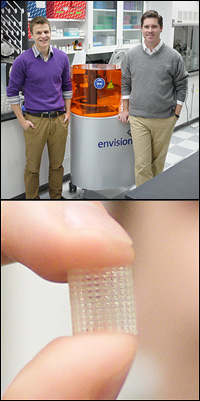
Fischell Department of Bioengineering Professor John Fisher and Fischell Fellow Anthony Melchiorri won the Best Inventor Pitch at the 2013 Professor Venture Fair, held as part of Bioscience Research & Technology Review Day. The duo's 3D-printed, customized cardiovascular implant system was one of four innovations presented by faculty members, research scientists and graduate students at the event, which took place November 19 at the University of Maryland. The win was the second for Fisher’s group at the competition. The annual Professor Venture Fair gives University of Maryland inventors the opportunity to present new biotechnologies to a team of regional venture capitalists and entrepreneurs. The competition encourages scientists to consider the commercial viability of their work and challenges them to explain their ideas to a non-technical or business-oriented audience. In his presentation, Melchiorri, who is also a Warren Citrin Graduate Fellow, described the patent-pending, biocompatible polymer that FormaSTEM, the company he has co-founded with Fisher, uses to create vascular grafts (artificial blood vessels). The grafts are used to treat a number of heart conditions. Fisher and Melchiorri would like to offer the polymer to researchers in the near future, and eventually see it approved for clinical use. What makes a FormaSTEM graft unique is that once implanted, it supports and acts as a template for the growth of blood vessel tissue. Its mechanical properties, strength, and elasticity mimic those of actual blood vessels. Because it is also biodegradable, the patient’s own tissue replaces it over time. By the time the graft is gone, a new, real blood vessel segment has taken its place, reducing or eliminating the need for further surgeries. Because the grafts are produced on a 3D printer loaded with FormaSTEM’s polymer, every patient can have one custom-made before surgery. Biomedical imaging techniques are used to create a 3D digital model of the patient's heart. The graft is designed in the computer to fit precisely in the damaged area, then “printed out.” This flexibility, Melchiorri explained, makes the FormaSTEM system an especially strong candidate for the treatment of congenital heart defects, which affect one percent of all live births. These defects are challenging to correct because each child’s problem is unique–there is no single implant or graft that can help them all. Currently, surgeons fabricate custom grafts based on adult models during the operation, adding time to the procedure. The grafts don’t grow with the children, meaning most will face multiple open-heart surgeries before they reach adulthood. FormaSTEM grafts could address all of these problems. “Our motivation is huge, because cardiovascular disease is the leading cause of death in the United States and in the rest of the world,” Melchiorri told the audience, adding that approximately 1,350,000 vascular graft procedures are performed each year in the U.S. alone. Fisher and Melchiorri’s win marks the fourth time in the competition’s seven years that a team led by or including members from the Fischell Department of Bioengineering has taken first place:
The Professor Venture Fair is hosted and sponsored by the Maryland Technology Enterprise Institute (Mtech), the university's Office of Technology Commercialization, the Dingman Center, and the College of Computer, Mathematical, and Natural Sciences. For More Information: Visit Professor Fisher’s Tissue Engineering & Biomaterials Laboratory web site
November 21, 2013 Prev Next |
|