























News
Simple Stretchable Conducting Material is Robust and Inexpensive
Electronic fabrics and skin are potential applications
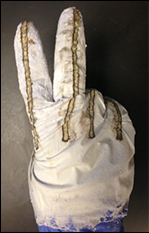
Materials scientists and bioengineers wanted to develop a method that would beat out the current state-of-the-art flexible conductive materials. Most of these are made on one surface and then attached to another. These materials are also somewhat stretchy, but tend to lose their ability to conduct electricity after being used. Mert Vural of the University of Maryland’s Department of Materials Science and Engineering and Adam Behrens of the Fischell Department of Bioengineering started with a flexible fibrous material, which joins together at junctions to make a spongy structure. By spraying on a layer of silver on top of that spongy structure, they were able to generate silver nanoparticles. The silver nanoparticles became the pathways to carry electricity. The silver’s many junctions ensure that even if the material is stretched the silver nanoparticles can find a conductive pathway and the current can successfully flow though. They worked with Dr. Peter Kofinas of the Fischell Department of Bioengineering and the Maryland NanoCenter. Other contributors to the paper include Omar Ayyub, a recent PhD in Bioengineering and Joseph Ayoub, an undergraduate in Materials Science and Engineering. They found that even stretching the material to one and a half times its original length kept their test lights on. This is far stretchier than other materials, which can usually only go to about double their original length. The new material retains its conductivity even over 2,000 cycles of straining. The researchers applied their new material directly to an ordinary lab glove, using a simple spray apparatus resembling a paint gun. Though some of the process keeps the new material from being directly applied on skin, the researchers are interested in seeing how this new material could be used in prosthetics or robotics. The simple processes used to make the new material mean that it could be used to manufacture stretchy conductors much more cheaply than competing materials. Sprayable Elastic Conductors Based on Block Copolymer Silver Nanoparticle Composites Vural et al, ACS Nano, 2015, 9 (1), pp 336–344 DOI: 10.1021/nn505306h
March 4, 2015 Prev Next |
|